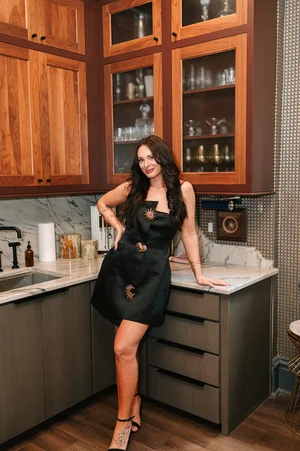
How to Design a Home That Feels Like You
A Home Stylist’s guide to reclaiming your space, your identity and your authentic style
Top trending searches right now are “how do I make my home look like me?” and, “how do I style my home authentically?”
There’s a shift happening away from constant trend cycling — and for good reason. When we don’t know how to listen to ourselves, we end up getting lost. We waste thousands trying to construct an image of what someone else has deemed “good” or “beautiful,” but more importantly, we lose our sense of self.
Our homes are so intimately connected to our self-expression — I would argue that they are self expression, whether we consciously realize that or not.
During the worst time of my life, I was outwardly showing the world how “successful” I was. I had the career, the car, the title and the travel, but my apartment, like my internal life, was a hollow shell.

Coming home to yourself doesn’t happen overnight. Trust the process — and more importantly, yourself.
I came home from putting on a show every day to nothing but an Ikea coffee table and a Walmart futon.
By any standard of “success” my inner and outer worlds did not match. Like at all.
Learning to Lie to Yourself
In my 20s, I had fallen into a cult organization that preyed on young, ambitious, driven people. I had fallen hook, line and sinker for a glamorous pyramid scheme that promised I would be glorified on the other side of sacrifice. I spent nearly 4 years grinding myself to the bone, pretending I was happy and successful, while really I was broke, sick, lonely and exhausted.
I lied to myself and anyone who came near me about how dire the situation was — mostly because I genuinely believed in the lies the cult told me.
I don’t blame myself for this anymore, but I still had to deal with the ramifications of lying and being lied to for years on end.
I had no internal sense of direction or reality — I didn’t even know what I liked. I had believed that by living in objective squalor, I was “sacrificing now for reward later.” It took nearly getting evicted from that hollow apartment for me to even partially wake up.
When I finally did leave, I continued to live in the same pattern of masking my inner world for several more years. I had lied to myself and everyone I know for so long, that I didn’t even know what was real. I didn’t know what I liked, who I was and even what I wanted.
Learning to Tell the Truth to Yourself
In the years that followed my time in the cult, I tried and practiced many helpful healing modalities, but the one through-line that has allowed me to become the author of my own life again has been my homes along the way.
From retreating to my childhood bedroom at 27 to eventually buying my first home at 30, I learned that home in any form is a place of grief, breakdown, reflection and recovery. It’s also a place of healing, expression, joy and creativity.
I discovered who I am through the places I’ve lived — up to and including the house I’ve lived in for six years now.
If you’ve ever had a total breakdown in the shower (who hasn’t?), then you know the deep sense of release that comes when you truly feel safe to break down. You don’t need to answer to anyone or anything.
You can just be — messy, broken, complicated and still alive, trying again tomorrow.
That’s what we need our homes to be for us — that and so much more. That's what authentic home design means to me — not a curated aesthetic, but a space that actually reflects who you are. It’s an expression of your style, of course, but it’s so much deeper than that.
Your home can be your sacred space, your healing chamber and your path back to sovereignty.
I know the power of healing through home. I know the beauty of finally seeing yourself clearly, maybe for the first time ever. And if everything came crashing down on me again today, this is what I’d do to rebuild from home:
Step One: Ground in Your NO (declutter your space)
The first step to dropping the mask — the old identity — is removing any evidence of it. The first thing I’d do would be to get rid of things that reflect what’s no longer real. Ironically enough, I just let go of that Ikea coffee table I mentioned not even a month ago. I was still carrying it around, all these years later. Sometimes, we don’t even realize little ghosts of the past are haunting the present.
Approach this with the mindset of turning the page.
Step Two: Connect to Your Power (choose color that empowers you)
Color is a power tool. Far too many people default to neutrals when they’re shut down, overwhelmed or lost and confused. The absence of color may calm your system for a while, but the presence of an intentionally chosen, meaningful hue will breathe life into your environment — and it will be a frequency that you choose.
This is what intentional home design actually looks like in practice: one deliberate choice that signals to your whole nervous system that you're back in charge.
I love painting ceilings because they draw the eye upward without even trying. Power move.
Step Three: Rearrange the Situation (move your furniture around)
I would need to declare my authority by setting up my rooms in ways that feel the best to me. The layout of a room can command and direct, or it can make you feel awkward and out of place. I'd set my space up to fit the way I actually live — designing my home around my real life, not some imagined version of it.
For me, conversations with friends are everything, so my living room would have to be set up gathering. Non-negotiable.
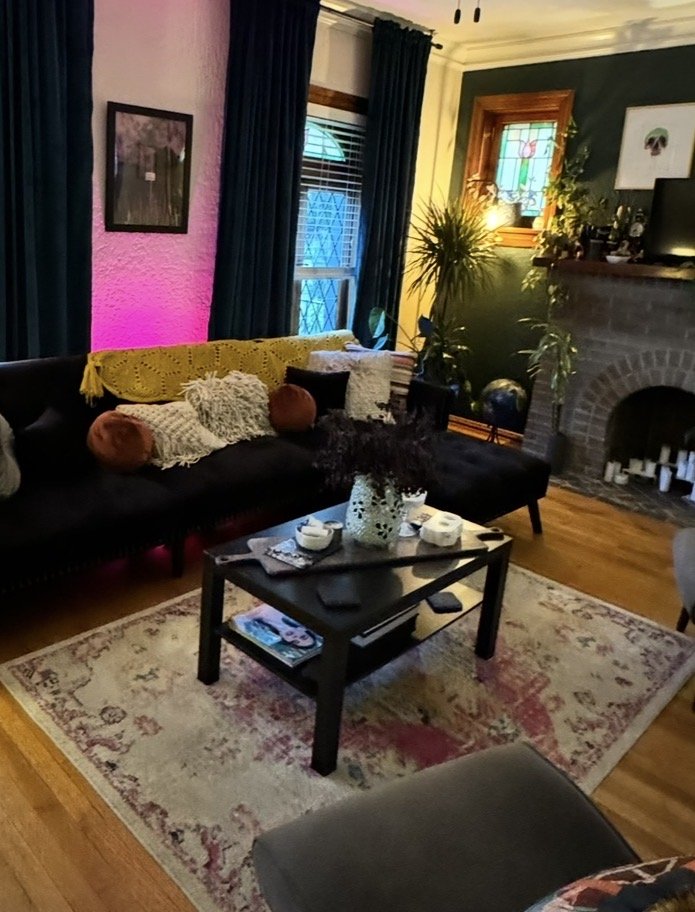
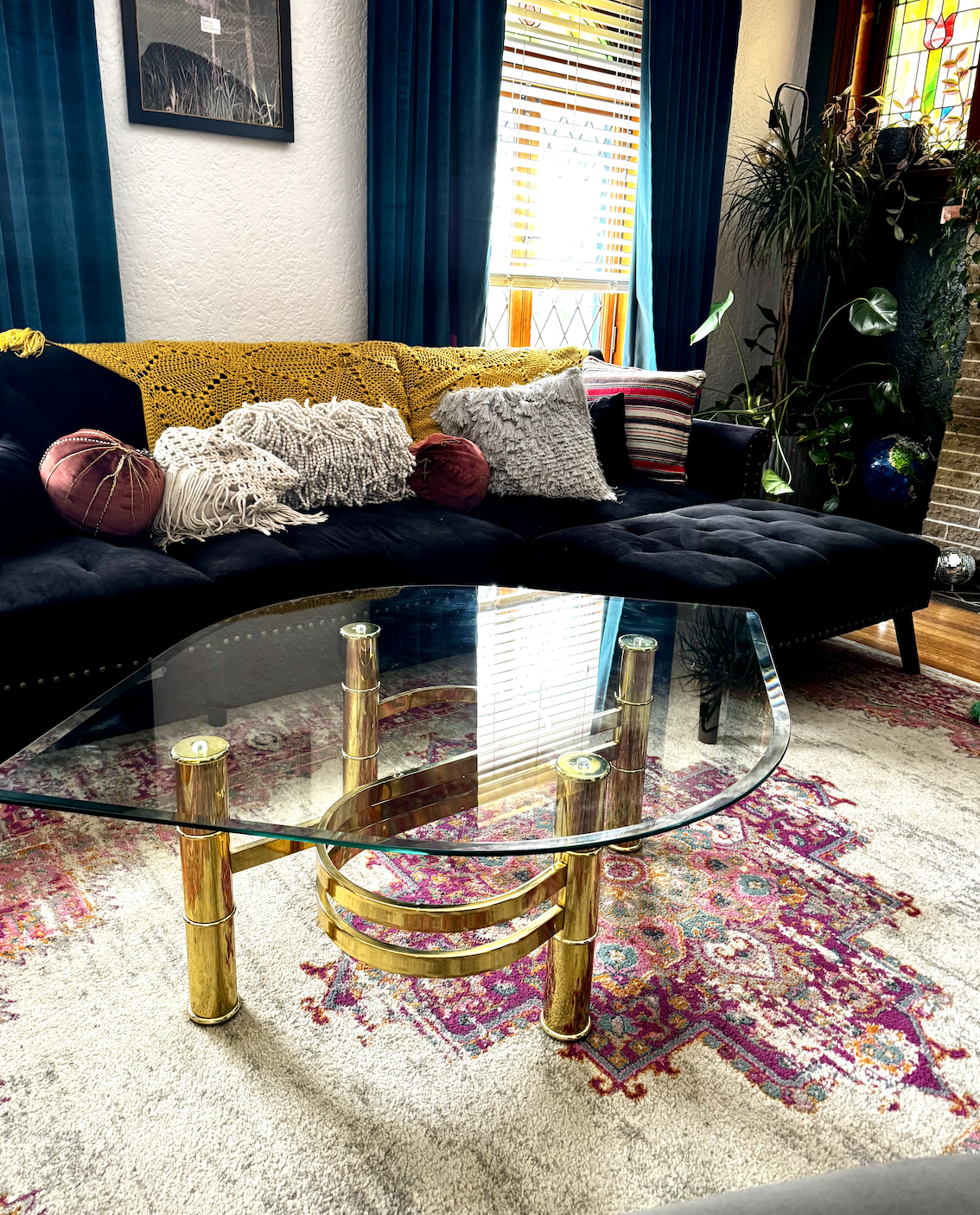
The Ikea coffee table with bad juju that I finally pitched, and the new one that’s much more me I thrifted a week later.
Step Four: Feel Your Feelings (integrate texture)
When I was a kid, if I had a stomach ache, I’d carry around a bath towel because I was so scared of not making it to the bathroom in time. To this day, the texture of bath towels soothes my stomach because I associated it with being comforted when I was sick. Weird way to say that texture has real physiological connections, so I’d fill my home with cozy textures and layers, and you should too.
Everyone is different when it comes to their physical senses as much as they are when it comes to color preferences. Choose textures for your home that feel right for you.
Step Five: Melt Like Honey (fix your lighting)
If you do nothing else (besides clearing space — do that), this step will alter how you feel in your home more than any other. Warm pools of soft light will do more for your nervous system and sense of safety than almost anything else.
The light in your home signals to your brain what should be happening. When you choose soft, warm, gentle lighting, you will feel softer and warmer.
Good lighting will help you unwind and even sleep better — which is crucial for healing.
Step Six: Make Your Home A Shrine to Yourself (decorate with only what you love)
Listen, I have watercolor nude portraits of myself on my walls, which I cannot recommend enough, but you don’t have to take it that far to adorn your home with your authentic essence.
This step is really about saying yes to the radically you pieces you find — regardless of what anyone else thinks. The weird stuff, the collected heirlooms, the travel finds — these are the unmistakably YOU pieces that need to be on full display in your home, loud and proud.
This is personal style in a home: not a mood board someone else made, but the actual stuff of your actual life.
I’d fill my home with meaningful art any time I feel like I’m getting lost.
Step Seven: Touch Grass (infuse your home with nature)
We all need to spend more time in nature, and that’s why I advocate for bringing it into your home literally or symbolically. Nature is abundance in its purest form, and inviting it into our sacred space connects us with something greater than ourselves, and at least for me, reminds me that growth is always happening even when it doesn’t look like it.
Drink water. Get sunlight.
Returning Home to Yourself
You just learned all seven steps in Alchemy of Home’s home styling method, The Foundry Formula. You’re literally already doing the work!
The Foundry Formula was created for these moments — the ones where you need grounding, a plan and someone to reflect the place you’re in back to you with clarity.
The Foundry Formula doesn’t chase perfect aesthetics, but rather it teaches you how to reconnect with yourself to create a home that’s as authentically you as it gets. I’ve done this for myself, and as a home stylist, I’ve guided and witnessed this transformation for countless others.
If this feels like the right thing for you right now, you can enroll in the self-paced Foundry Formula course, and even add on the Shedding & Redefining Identity Pathway to tailor the course exactly to this moment.
The course will lead you through each step of the Foundry Formula, allowing you to move at your own pace and make decisions within your own budget, and the optional Pathway will give you even more specific focus and support.
If you like what you see but you’re not ready to join in yet, I’d love to have you in the Alchemy Archive Newsletter — it comes out every Sunday and will keep you connected to the Alchemy of Home, wherever you are in your own relationship to home.
See you there.
Written from home,
Liz
P.S.If you live in St. Louis, MO, I’m hosting a pop up event locally and I’d love to have you. Sign up for the newsletter for location and details!