How to Thrift Home Decor as a Beginner
Learn to thrift for your home in seven steps— even if you’re a total beginner
Learning how to thrift home decor can completely change the way you style your home. Whether you’re searching for vintage furniture, affordable home decor, or unique thrifted finds that make your space feel collected and personal, thrifting is one of the best ways to create a beautifully designed home on a budget.
Everyone is thrifting home decor these days, and admittedly, some of us have an easier time of it than others. Me, for example? Baby I can thrift for my home like it’s my job (it is, and you should come to my next live event if you live in St. Louis, MO), but when it comes to thrifting clothes, I’m basically useless.
Decorating your home with thrifted decor is a skill — thrifting at all is a skill, and it takes practice to get good at it.
At first, it’s really overwhelming, and we usually end up making impulse decisions, wasting money and then giving up, thinking we’re just not good at it.
I’m here to tell you that’s just not true. There’s no manual out there that teaches you how to find your authentic home style (oh wait, I made one 🤗) or how to learn how to thrift for interior design (hint: you’re reading that now).
Learn How to Learn How to Thrift Your Home Decor
What I mean to say is, sometimes we struggle to learn something because we don’t come at it with the right mindset. We can’t learn a new skill until we learn how to think about it. So, if you want to learn how to thrift home decor for your space, this is the quick guide you need.
First though: Why Thrift?
Thrifting is a sustainable way to style your home. You’re buying things that have already been made and used, you’re supporting a small business and you’re consuming less since you’re not buying new! Hella wins!
It’s value-driven. You can more often than not find incredibly well-made pieces at a fraction of the cost of buying new — and they’ll last you way longer than modern-made pieces will
You’re supporting communities. Thrifting is community-driven — these things are passed on by people through resellers and small businesses. You’re doing your part in your community when you thrift locally!
There’s something for everyone: What resonates with you?
eclectic interiors
collected interiors
vintage-inspired homes
layered home decor
soulful interiors
moody interiors
maximalist decor
cozy home styling
curated spaces
No matter your style goals, you can incorporate thrifted home decor as your primary style or just infuse some thrifted pieces to give your space character and charm. Okay, so let’s learn how to thrift for your home:
Step 1: Learn to Say No (declutter your space first)
If you don’t know what to look for when thrifting home decor, let’s start with what not to look for. Before you buy anything, go through your own things and start saying, “No.” You need to be able to get clear on what you don’t like before you can connect with what you do like.
This is extremely important if you plan to style your home on a budget — more clarity = more money saved and less money spent on the wrong things.
Step 2: Refine Your Color Options (choose a color palette to work with)
You’re going to say yes to too much or get overwhelmed if you don’t have some guardrails — at least at first. Nail down your color palette before you start shopping, that way you don’t get sucked into things that don’t actually make sense for your space.
Also, let go of perfection — when thrifting for home decor or furniture, nothing will ever match perfectly — that’s the whole point. Thinking of colors in ranges or families will help you not feel paralyzed when hues don’t match tone for tone.
Step 3: Find Quality Thrifted Furniture
One of the best parts about thrifting furniture is that the quality can be so high yet so affordable. Nowadays, everythingggg is made so cheaply, it feels like it’s basically crumbling within just a few years. Once you set your sights on something — a thrifted desk, cabinet, etc, you will be blown away by how many unique, well-made pieces are available at absolutely amazing prices.
Don’t rush this — it’s normal for it to take time to find the right piece. It takes patience and a willingness to evaluate quality and price rather than just buying with one click off a big box retailer’s site.
Step 4: Embrace Texture (what to look for when thrifting home decor)
Texture, wear, patina and imperfections are normal, expected and often loved in thrifted home decor. The real question is not “Is this okay?” but rather, “Do I like this?” Any amount of wear or imperfections are okay, as long as it’s functional in the way you need it to be and it’s not damaged to the point of needing repairs you’re not willing or able to do.
A lot of people get wild ideas about something they love but is just a little too broken. Before you start thinking you’re going to rescue a piece, be serious about your skills, the time and money it will take to do that. For some, furniture flipping or decor restoration is worth it and fun. For others, it’s a pipe dream waiting to drain your bank account. Know thyself.
Step 5: Thrifted Lighting Doubles as Art (how to choose vintage lighting)
If you’re new here, you may not know I’m addicted to lighting. If you’ve been around the block, sorry you had to hear that again. Lighting is one of the most effective ways to create a very intentional atmosphere in your home, and it’s one of the first things people gravitate to when they first start thrifting. I don’t really know why, maybe because they’re literally lit up in the stores? Shiny object? Squirrel?
The cool thing about thrifting your lighting is that vintage lights automatically warm up a room. It’s a literal crime in my world to put cool LED lights inside thrifted lamps, so just don’t do that, okay?
Otherwise, go crazy. You’ll be able to find vintage lighting in all kinds of sizes, shapes, styles and eras — the main things you need to keep in mind while shopping are where exactly you’re going to place the lamps (or pendants, sconces, whatever) and if they’re the right size/proportion for that spot. It can be helpful to write down a rough idea of the type of lighting you’re looking for before you even start shopping so you don’t wind up buying something super pretty that makes no sense in your home. (Though, I’m ok with a whimsy purchase now and then.)
Step 6: Know the Difference Between Art and Décor
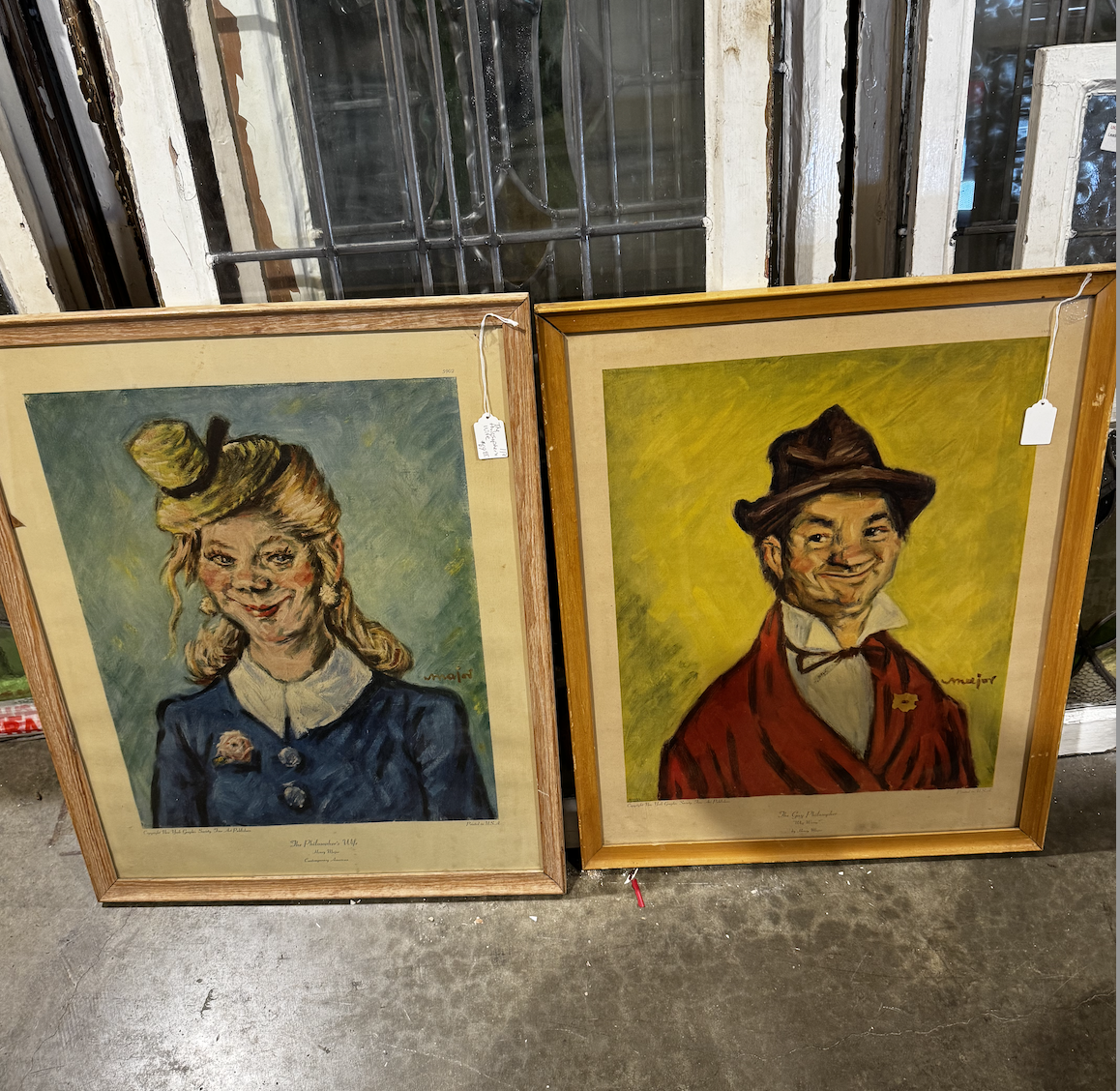
One of my best friends just thrifted these: The Gay Philosopher and The Philosopher’s Wife. There’s truly something out there for everyone!
There’s a LOT of décor to thrift out there — some of it monetarily valuable, some of it not. When thrifting art and décor, value is often less about money and more about meaning.
While there’s some expensive art out there to be sure, what’s more important is the meaning connected to the pieces you’re buying. Thrifting filler décor excessively is where most people slip into chaos-land, buying way too many trinkets that wind up feeling junky rather than curated.
Not every space needs to be filled at once, and it takes restraint to learn the difference between art that’s meaningful to you and décor that just fills up a cart. Both feel good in the moment, but one category lights you up forever, and the other collects dust on the mantel. Practice learning the difference.
Step : Incorporate Natural Vintage Decor
Often, old, vintage, antique and thrifted pieces are made of natural materials — and often they’re not. There’s no moral case being made here, but pieces made of natural materials are generally going to feel more luxurious, sturdier, more durable and overall more quality.
Examples: Look for wood furniture, metal or wooden picture frames, linen or cotton textiles and fabrics, stone, clay, brass or crystal vases, vessels and figurines. Check labels and original stamps. It’s ok if not everything you buy is straight out of the 1800s — or even the 1900s! What matters is that you get good quality pieces you like at a price you like even better. That’s not always possible, but at least this effort is worth not wasting your money!
Just because something is at a thrift store does not mean it’s good quality. Even if you find pieces that are synthetic, do take the time to evaluate the quality compared to price. You’ll notice natural materials stand the test of time and feel more authentic to the whole point of thrifting.
FAQs About Thrifting
Is thrifting home decor cheaper?
Not always, but often and in the long run — yes!
What days are best for thrifting?
It totally depends on the store — visiting your favorite spots regularly, even more than once a week if you feel like it, will turn up new finds every time.
How do you find good home decor at thrift stores?
Patience, friend. Keep a list in your phone of pieces you need and when you see a fit, check for damages, check the price, and if it lights you up, snag it.
What should beginners thrift first?
Beginners should have a priority plan based on their situation and home — our self-paced home styling course, The Foundry Formula, teaches you how to prioritize based on your own home and your own needs. The course is just $89, and you can add on or start with our new Home Thrifting for Beginners Pathway ($22)
Is thrifted furniture safe?
You must evaluate each piece — from furniture to lighting to art — to check for stability, structural damage, wiring, rust, sharp edges, etc. In extreme cases, check for mold, bugs or other pests. Most stores will have already done this, but you should always double check.
How do you clean thrifted decor?
Cleaning depends on the item. It’s best to get as much detailed info on it as you can observe, then google how to clean or care for that kind of object. When in doubt, be as gentle as possible.
How to Start Thrifting Today
Hopefully, this guide got your gears turning and you’re excited to start thrifting pieces for your home! You can have all the information in the world, but actually getting out and doing it is what will ultimately transform your home.
When you click out of this page, you may realize you need some ongoing support, which is why I previously mentioned our home styling course, The Foundry Formula. This $89 course is a self-paced, self-budgeted home styling system that walks you through 7 distinct steps to styling your space, teaching you how to connect with your authentic style and prioritize change effectively — no more spinning out with decision fatigue.
The Foundry Formula stands alone with everything you need to transform your space on your own with expert guidance by your side (read more about it here), but if thrifting is on your mind, you can also add our tailored Home Thrifting for Beginners Pathway.
Our Pathways ($22) are very accessible starting points or tailoring tools to use alongside the course if you want deeper, more transformative support.
At the end of the day, styling your home is a practice and skill, not a one and one static decision. I’d love to share more insight with you in the future, so please consider joining our weekly newsletter, the Alchemy Archive. There’s a free Weekend Home Style Reset guide waiting for you there, too.